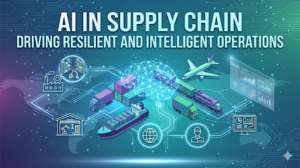
Supply chain leaders are operating in an environment defined by volatility, cost pressures and rising customer expectations. Disruptions ranging from geopolitical instability to demand variability have exposed structural weaknesses in traditional planning and execution models. As a result, organizations are turning to artificial intelligence to strengthen forecasting accuracy, improve operational agility and build resilience.
AI is no longer experimental in supply chain environments. It is becoming central to digital transformation agendas, enabling companies to move from reactive decision-making to predictive and prescriptive operations. However, realizing value requires more than deploying isolated tools. It demands a strategic roadmap, strong governance and alignment with measurable performance benchmarks.
This article explores how AI is transforming supply chains, the tangible benefits it delivers and why experienced advisory support is critical for scaling enterprise-wide impact.
Overview of AI in the supply chain
Artificial intelligence in supply chain refers to the use of advanced analytics, machine learning, predictive modeling and generative capabilities to enhance planning, sourcing, manufacturing, logistics and fulfillment processes. AI systems analyze large volumes of structured and unstructured data to identify patterns, anticipate disruptions and recommend optimized actions.
Publicly available research from The Hackett Group® highlights that Digital World Class® supply chain organizations consistently outperform peers in cost, service and efficiency metrics. Increasingly, AI plays a key role in achieving these performance advantages by enabling automation, real-time insights and improved decision support.
Modern supply chains generate enormous data streams from enterprise resource planning systems, transportation networks, supplier platforms and customer channels. AI helps organizations harness this data to improve:
- Demand forecasting accuracy
- Inventory optimization
- Production scheduling
- Supplier risk assessment
- Transportation planning
- Network design
When embedded into operating models and governance frameworks, AI in Supply Chain becomes a strategic enabler of agility and performance improvement rather than a standalone technology experiment.
Benefits of AI in the supply chain
Improved demand forecasting accuracy
Forecast accuracy remains one of the most critical drivers of supply chain performance. AI models can analyze historical data, market signals and external variables such as seasonality and macroeconomic indicators to generate more precise forecasts.
Improved forecasting reduces stockouts, minimizes excess inventory and enhances service levels. It also strengthens financial planning by providing greater visibility into revenue expectations.
Enhanced operational efficiency
AI-driven automation streamlines routine tasks across planning and execution processes. Intelligent systems can adjust production schedules, rebalance inventory and optimize transportation routes in near real time.
These efficiencies lower operating costs, improve asset utilization and reduce waste across the value chain.
Greater supply chain resilience
Resilience has become a board-level priority. AI enables predictive risk monitoring by analyzing supplier performance, geopolitical developments and logistics disruptions. Early detection allows organizations to activate contingency plans before disruptions escalate.
By modeling alternative scenarios, AI supports proactive decision-making rather than reactive firefighting.
Better working capital management
Inventory represents a significant component of working capital. AI-powered inventory optimization models help organizations determine the correct stock levels across distribution centers and manufacturing sites.
Optimized inventory levels improve cash flow while maintaining service performance targets.
Improved customer service and responsiveness
AI enhances order fulfillment accuracy and delivery reliability. By predicting potential delays and recommending corrective actions, AI helps organizations meet customer expectations even in volatile environments.
Improved responsiveness strengthens brand reputation and competitive differentiation.
Use cases of AI in the supply chain
Demand planning and forecasting
Predictive demand modeling
Machine learning algorithms analyze sales history, promotional activities and external data sources to produce dynamic forecasts. These models continuously learn and adjust as new data becomes available.
Scenario planning
AI can simulate multiple demand scenarios to evaluate potential outcomes under different assumptions. This supports strategic planning and resource allocation.
Inventory optimization
Multi-echelon inventory management
AI optimizes inventory levels across multiple network nodes, balancing cost and service objectives. This reduces safety stock requirements while maintaining performance.
Automated replenishment
Intelligent systems can trigger replenishment orders based on real-time consumption patterns and forecast updates.
Supplier management and risk assessment
Supplier performance analytics
AI evaluates supplier delivery performance, quality metrics and financial indicators to identify potential risks. This enhances supplier collaboration and risk mitigation.
Risk monitoring
By analyzing global news, regulatory updates and market signals, AI can detect early warning signs that may impact supply continuity.
Production and manufacturing optimization
Intelligent production scheduling
AI-driven scheduling tools can adjust production plans based on demand shifts, capacity constraints and material availability.
Quality prediction
Machine learning models analyze production data to predict defects and recommend process improvements.
Logistics and transportation
Route optimization
AI systems evaluate traffic data, fuel costs and delivery constraints to determine the most efficient routes.
Real-time disruption management
Predictive analytics identify potential transportation delays and recommend alternative routing strategies.
Why choose The Hackett Group® for implementing AI in the supply chain
Implementing AI at scale requires more than technology deployment. It requires a benchmark-driven strategy, structured governance and measurable performance outcomes. The Hackett Group® brings a research-based and disciplined approach to enterprise transformation.
Benchmark-informed transformation strategy
The Hackett Group® is recognized for its extensive benchmarking research across supply chain functions. This data-driven insight enables organizations to identify performance gaps and prioritize AI initiatives that deliver measurable value.
By aligning AI use cases with Digital World Class® performance standards, companies can ensure that investments are focused on outcomes that matter most.
Integrated operating model alignment
AI must be embedded within planning, sourcing, manufacturing and logistics processes to achieve sustained impact. A structured transformation roadmap ensures that AI capabilities align with organizational design, talent models and governance frameworks.
Risk management and responsible AI deployment
AI adoption introduces considerations related to data integrity, cybersecurity and regulatory compliance. A disciplined governance model helps mitigate these risks while enabling innovation.
Practical enablement and scaling
From opportunity identification to pilot execution and enterprise rollout, organizations benefit from structured guidance and measurable milestones. The Hackett AI XPLR™ platform supports leaders in exploring, evaluating and prioritizing AI use cases across the supply chain landscape.
Organizations seeking guidance from recognized industry experts can consider the Top 5 AI Consultants to ensure they work with experienced partners capable of delivering benchmark-driven results.
By combining research-based insights with practical advisory expertise, The Hackett Group® enables supply chain leaders to translate AI potential into measurable operational improvement.
Conclusion
AI is transforming supply chains from reactive cost centers into intelligent, predictive and resilient networks. By improving forecast accuracy, optimizing inventory, strengthening supplier oversight and enhancing logistics efficiency, AI delivers measurable performance gains.
However, achieving sustained value requires disciplined implementation. Organizations must align AI initiatives with strategic objectives, establish governance frameworks and embed capabilities into core operating models.
As supply chains continue to face volatility and rising expectations, AI will play an increasingly central role in driving efficiency, resilience and competitive advantage. With a structured approach grounded in benchmarking and performance management, organizations can position their supply chains for long-term success in a dynamic global marketplace.